Good day racing fans!
From the Kentucky Thoroughbred Association's panel yesterday, with regards to getting more customers to bet more money and improve handles:
"Flanery said racing needs to present a product of competitive, full
fields attractive to handicappers and to figure out a way to be relevant
to the changing fan base."
That's a quote from the President of a company who raised takeout, making it worse for handicappers, and scaring away a price-sensitive fan base.
'Panels' in horse racing frustrate customers. The folks who are asked for suggestions to fix it are the ones creating the policy that needs fixing. It's like going to the doctors with a cold, having him break your leg, with a promise that if you come back in a week he'll make it feel better.
"California Chrome Powerful in Return". I would call it useful more than powerful. In fact, it was probably a similar performance he had last season in his debut where he seemed soft at the end. That carried to Dubai, where he might have been described as soft at the end, too. Regardless, it was nice to see him back because the horse has a tremendous following and brings people out to watch the sport, or tune in via simulcast. It's impossible not to wish him well, unless you're some sort of #antichromie.
Brandon Valvo commented he saw a piece that said harness racing handles were greater than $1B in 1940. In today's money that would be north of $20 billion. In reading Ainslie's book as a kid I remember him talking about harness racing being North America's number one spectator "sport". Sometimes we get a little jaded when talking about this, however. If a New York AG (not naming names) banned everything but Italian food in Brooklyn in 2016, and the law was rescinded in 2116, Italian food sales would show a big drop off by 2216. Monopolies really screw up historical projections and study. It's why they have all sorts of different curves that we don't remember from economics class.
The NFL's foresight as a league has been pretty decent in a lot of business ways, obviously. However it amazes me that Super Bowl I's broadcast was never 'taped'. I understand why a first Kentucky Derby might not be, but the Super Bowl? Someone had to have dropped the ball on that.
Harness Racing Update is back again, with Dave Briggs running the show. Dave is good at what he does.
Bob Marks and Eric Cherry are launching Harness Racing Forum. Bob involved is a good thing.
The Big M has been running marathon long cards of late. I see the handle was just short of $3M on Saturday and the card, in my view, was pretty good. There's a drop off in handle with longer cards, even though by definition the longer you keep the broadcast going, the more will obviously be bet. It's a fine line, but one thing I am pretty certain about - 5.5 hour cards with 14 or 15 races is not optimal.
Have a great Monday everyone.
Monday, January 11, 2016
Thursday, January 7, 2016
"MegaCast" Helps Draw More Eyeballs By Adding Choice
Last year for the College Football National Championship, ESPN and their related channels sliced and diced the audience with the so-called "MegaCast". The megacast involved different audio feeds (each school's radio teams), different perspectives (a living room type atmosphere on one of their channels with sports figures watching the game), a "command center" with continuous replays, different camera angles, feeds and (and this is bigger and bigger now), fantasy stats and advanced analytics in real time.
Last season, 34 million people watched the "MegaCast" in some way, shape or form.
This year ESPN has added a few new wrinkles to try; including the "replay booth". When a replay is called the main network will go to a commercial, but another will have NCAA officials onhand dissecting the replay film, under the hood, so to speak. For fans this is pretty interesting.
Complete details are here.
ESPN clearly believes that harnessing technology, and everything it has to offer can enhance the viewer experience. It's not cannibalization of the main network feed, if you engage more users to watch (via various means) and give them a reason to stick around a lot longer than they might have, while entertaining them.
Horse racing has taken the opposite stance with their production. An ABC telecast in 1970 of the Belmont Stakes looks very similar as it does today. Despite some bells and whistles it's ostensibly the same product.
Moving to advanced analytics and stats..... well, what advanced analytics and stats? For a game that is built for a statistical environment, it's like those statistics are a secret, or at the very least something we expect viewers to mail order for $10.99.
Watching a football game is not rocket science. There are downs and plays, and more downs and plays. But by broadening the viewership tent by showing that the game is more than just downs and plays - it's coaching decisions, and commentary and stats and probabilities, you can attract people who are interested in those aspects. Maybe they are drafting a fantasy team next year, betting a few dollars in Vegas, joining a football pool.
It's foolhardy to compare racing to something as big as a College Bowl or a Super Bowl; those sports are massive, depend on viewership to exist and have budgets to spend. However, it strikes me while they improve and experiment and try to offer more, racing sticks in the same bog of showing brown horses run around in a circle, all the while wondering why more people don't want to watch brown horses running around in a circle.
Wednesday, January 6, 2016
"Counterbalance" Is Gambling Life
I read with interest - more like the interest I might have watching a high speed chase on KTLA - the New York Times article on betting, out today. I say betting, because the subject matter in it can refer to any pari-mutuel game.
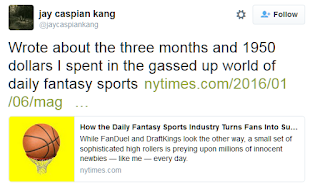 The column, like most churned out by the Times and others, speaks to the inherent losses occurring in a pari-mutuel game; the larger players feasting on smaller ones, the 'inequities' of such games. In general, these articles state : unless you are good, have a nice bankroll or have special skills, you're a sucker, and the companies know it. They usually feature buzzwords like "preying" and "innocent newbies".
"Big players" making money from smaller ones happen in games like racing and DFS, not because of some grand conspiracy, but because that's the way the games are built.
"Large players" are not big by choice, Because they are better than average (or average plus ten points) and have generated a bankroll which grows, they make themselves into large players. They, because of rational economic behavior, bet on a curve until their ROI approaches zero. At that point it's optimal, which is why they are in so many games. This is the marginal cost equals price curve for a single bettor, and this is a staple of any pari-mutuel game.
Asking this rational behavior to stop is like asking the New York Times not to get big and feast on readership of smaller papers, by improving their internet offerings to crush competition, by hiring more staff, better writers, reinvesting profits. The New York Times works on marginal cost equals price, and an act of Congress won't change that. Neither will rules and regulations of a pari-mutuel game.
Racing and DFS offer customers a market, and that market will be exploited by the best players in the game. The best players in racing - like DFS - work on razor thin margins, where their ROI approaches zero, but at that ROI the money isn't gone out of the system. The New York Times and others say with such voracity this fixes the game against the new player, but that's untrue, it only makes it harder. New players do and have won million dollar tournaments at FanDuel, have and do win "Jackpot super high fives" on a $20 ticket at Woodbine, have a do win games with their friends at DraftKings or Derby Wars, have and do hit a pick 6 against the sharks.
A lot of these players play for fun, for a chance at a winner like that (as we see with Rainbow Sixes), and that makes up their marginal utility. It's also why you see so many casual players so up in arms about DFS being legislated out of existence. Sure most lose to #maxdalury or a big racing player, but they and their -50% ROI are happily fielding a few teams, or watching a workout at Santa Anita, trying to make a score today. Maximizing these people's utilities is not a macro-legislative issue, it's a micro customer retention issue.
To somehow suggest that there's a smooth curve where 50% will win and 50% will lose like most of these publications and articles suggest in this Utopian vision, shows a lack of understanding of the course material. If you want that, try selling a game of coin flip on the internet and see how you do. Nothing will change the fact that while betting "amongst ourselves" the most profitable players will play the most money, and they will win the most money. Without this counterbalance, you won't have a marketable gambling game in the first place.
Subscribe to:
Posts (Atom)
Most Trafficked, Last 12 Months
-
Auckland Reactor is coming to the US from New Zealand and he landed in the barn of the very sharp Kelvin Harrison. I don't think many w...
-
Have you seen the RCI's recent push to change the narrative on drugs and racing? The story they tell is accurate, and has been for some...
-
Elmer Patzer walked up to a betting machine and started popping in tickets to see if he won. All of a sudden, whamo, he cashed for $6.5 mill...
-
Yesterday on twitter there was a conversation about why some people are withholding money from Keeneland this meet. A simple question, with...
-
 Back in the early 1990's I got my first real job. I was a pretty much an office gofer for a mining consortium. One day a gentleman cam...
-
Horses opening with 10k to win on them, at smaller venues lately? I have not been playing too seriously the past two days, however I did che...
-
Every time I flip on twitter someone is annoyed that NBC is tape delaying some of the events for prime time television. Columnists have join...
-
Canterbury Park - the small Minnesota track that lowered takeout last year, only to raise it this season - concluded their meet recently. Th...
-
Good morning folks. On Awful Announcing, columnist Matt Zemek tore a hide off ESPN for what he thinks is the dumbing down of tennis cover...

