Tuesday, March 8, 2016

The Party of No, Complicated Bets and a Tuesday Catch-Up

Good day racing fans!

Paulick has a story up on exchange wagering - the buy and sell market that people call new, but is in fact old now - as well as a poll. The poll, "do you want to see exchange wagering in your state, yes or no", has the no side winning.

Question: Does any poll in horse racing that offers customers something new, at a better price, (or something else they want) ever not answer "no" from insiders?

I don't remember too many; which makes the lament, the hand-wringing, and the wonderment from insiders why handles have been down for 15 years all the more perplexing.

Racing builds walls, and customers pay for it. And I don't think Mexico will help.
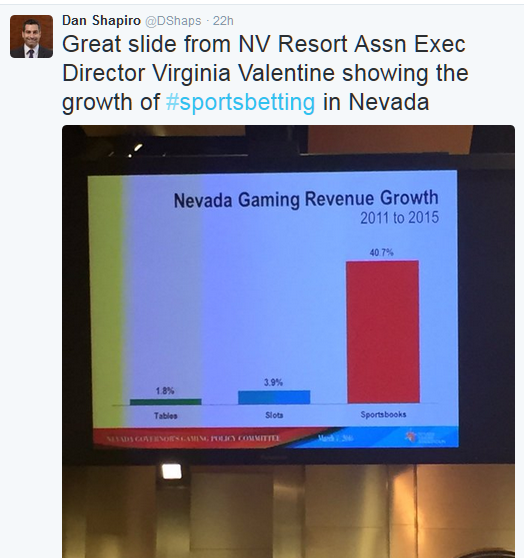
Meanwhile back at the ranch, sports betting is growing, by giving customers what they want. This has been happening in tandem with the massive rise of Daily Fantasy Sports (which did $3B in handle last year).

Las Vegas sports betting seems to keep setting new handle records each month.

It amazes me that Daily Fantasy Sports - which did not even exist in any major way five years ago - and sports betting has grown so much in this space. At the same time, racing, with an Internet betting monopoly seems to be losing more and more market share. 

Cangamble believes that horse racing should "market the heck out of the trifecta".  CG believes that horse racing being "too complicated" is a bad argument and I tend to agree.

What's easier to understand than 'pick the top three in this race and win money'?

To me, slots are complicated. I have no idea how to play those games; you know, the ones where you win on diagonal lines, or four corners, or whatever. I was at the convenience store the other day and had a look at some of the lotteries while I was waiting in line. I had an easier time understanding first year calculus. No, racing is not complicated; I think it's just another excuse.

CG also talks about drug use and it not having an effect on the players. Maybe so, but drug use has an effect on horse supply and ownership depth, which does influence handles. Three horses from one trainer and two from another in a seven horse field is commonplace and it makes for some pretty boring betting. 

This weekend I enjoyed the racing, including the most-excellent performance by Songbird. There's some wondering if the Derby field will ever be fewer than twenty horses. I think not, because the ego gratification of having a Derby starter is too much, but what about the Oaks this year? I could see that being a six horse field. Who wants to face her?

CJ on the GP handicap this weekend, where Valid was badly interfered with by one of the Pletcher horses.

This is a little known rule, that could be enforced (but wasn't nearly enough) with coupled entries.

Peyton Manning retired and a lot of folks said "ho hum", as is often the case with some athletes. The sports world is filled with narratives, and if a negative narrative takes hold, it's hard to appreciate what we just watched.

By all means, Tigers Woods, Peyton Manning, Wayne Gretzky - whomever - can be disliked for whatever reason, but we can't forget how great they play or played the game. I find this is similar with horses. Sure we'll never know how good American Pharoah might've been, we see California Chrome not win a dirt race for awhile, and Zenyatta win some races on "plastic". But appreciating great horses - for their speed, longevity, moxy, will to win - is never a bad thing. When they're gone we miss them.

Unless the announcer idol thing in California was pre-determined, I think Michael Wrona will win the job.

Congrats to Red Mile, Hialeah and Pompano Park main man Gabe Prewitt for winning the rising star award at the Dan Patch on Sunday. Deserved.

The Meadowlands has a tough time this time of year with entries. They don't have slots, but the slots rich tracks that orbit around them do. One thing the Big M has, though, is handle. They keep leading the sport with customers, regardless, and it's not really that close.

Election betting is growing and it's never not fascinating. This year, however, the swings in the states have been flat out incredible. I've been doing this with a bankroll since 2000, and I have not seen anything like it.

Horses are animals and sometimes they lose their edge, sometimes something is bugging them where the world's best vets can't even find it. Sometimes they just need a break and that's what's happening with the Pizza Man off a couple of flat efforts. Horses are incredible beasts because they want to please and they run through maladies. But sometimes they just lose that punch, and that can mean a lot at the highest levels.

Harness racing can increase purses and bring in betting dollars, but grabbing a slice of those dollars for a CRM plan, or to sink some money into owner and customer cultivation seems like a non-starter. This was examined in Harness Racing Update, page six.

Have a nice day everyone.

Wednesday, March 2, 2016

Seamless Consumption, Today's Betting Sites Need to Compete, Allowed all Content

Dana passed along an article today on the twitter about marketing on the web. Generally, it's about the buying process and how things have to be pretty seamless in this new world we live in. Give it a read if you're interested.

For sports' properties, this is paramount. NHL.com, MLBTV, NFL.com all work towards not only keeping you engaged, but allowing you to purchase their products - tickets, jerseys etc - and, if you wish, watching their games right on the web. It's a one stop shop, and they do what needs to be done for you as a customer to maximize your utility (and their bottom line).

In racing, It doesn't quite work like that.

DRF.com is the granddaddy of all racing websites. Not only does it have a history, it supplies past performances, news, up to date betting information and of late, through DRFbets.com, a betting platform.


What every customer wants is included in their offerings, and just announced, it gets even better. DRF will be offering lower takeout to their customers.

So, this is great, right? An industry portal - in effect a face of the sport that's extremely recognizable, even to newbies or non-fans - has everything everyone would need; has everything an NHL.com, or MLBTV, or NBA.com has.

Not so fast. It doesn't have Churchill Downs content; Arlington, Fairgrounds, CD itself. CDI doesn't sell them their signal.

You can signup, want to become a fan with a flagship website, but you can't bet the Risen Star or the Arlington Million. To do that, you as a customer, have to sign up for another ADW account. This isn't a website that isn't working seamlessly, with a poor landing page, or a hard to find button to complete a call to action. This is having to go to a complete other site and signing up all over again, depositing money, and all the rest.

Back in 2008, when the Horseplayers Association of North America was formed, one of the planks, written by members and confirmed through polling, was that all racing companies should sell their product to all ADW's - you can't pick and choose, as long as they are accredited, legal sites -  so customers do not have to have three or four accounts to bet all tracks.

8 years later, DRF.com - the biggest site in racing - does not even have all tracks.

We understand why; we get it. This is how racing works, and I don't want to get into legal mumbo-jumbo about anti-trust. But in the big picture (which in my view racing pays little attention to) : When your sport is trying to compete for gambling dollars, when you are trying to keep money onshore, and not going offshore (where all sites take bets on everything, with a nice rebate), where today's internet customer demands seamlessness and a great user experience, you're poking them in the eye with a stick.

Customers win when sites like the DRF and many others have all content - these sites promote, offer price breaks to cash-starved players, and compete for betting dollars and new customers. If you, as a racetrack, are not selling your signal at a fair price to all other legal outlets, you should be. When customers win the sport wins, and the sport of racing needs to start winning a hell of a lot more often.


Tuesday, March 1, 2016

2016 Handle Numbers Show a Maturing Landscape, Some Learnings


Soon enough, February handle numbers will be released showing an approximate 6% gain. While people tend to focus on the top end, and get down in the dumps or giddy about the short-term big number (in this case, giddy), it's much more enlightening to look deeper into them.

What we have seen, of late, is the bigger signals doing better, while the smaller ones are stagnating. The big signals are doing several good things, along with an obvious handle boost - racing more races.

Case in point Gulfstream. In February 2015, GPX raced 216 races and garnered $176M in handle. In February of 2016, handle skied to $219M on 240 races.  Handle per race rose from $816k to $915k, a nice increase.

The approximate 6% increase in handle for the entire sport from 2015, came almost solely from this Gulfstream handle increase.

Other big signals, concentrating on carding some better racing, have done well, too, though. Aqueduct raced 17 more races and gained almost $18M in handle.

Overall, January and February date adjusted handle for the entire sport is up by about $60 million, or 3.9%. Since January 1st, Gulfstream is up about $62 million, Aqueduct is up $39.7 million.

Keep in mind the above numbers are from a database, and not official Equibase data.

What does this tell us? I think a few things.

i) When we see gross numbers, we have to take them with a grain of salt, because the make-up of industry supply is changing. We're not comparing apples to hand grenades, but we are comparing apples to a lightly less appley fruit.

ii) Big winter signals like Gulfstream and Aqueduct are working hard at their product and should be commended. I don't think you'll find many tracks that fly Serling down to do commentary, or spend so much on their signals, or spend time in the race office carding better fields like GP does. Money is pivoting into them.

iii) There is money on the sidelines for bettable horse racing. i.e. if you give people something exciting and worthwhile to bet, they'll bet.

We're not seeing industry "growth" here, in the true sense of the word. But I think we're seeing a maturing industry when it comes to carding races, racedate distribution, and other intra-racing measures.

Comparing two months from this year to two months to last year, as I have done above, has its own pitfalls. We'll see if these are trends, or simply blips, in the coming months. 

Enjoy your day everyone.


Most Trafficked, Last 12 Months

Similar

Carryovers Provide Big Reach and an Immediate Return

Sinking marketing money directly into the horseplayer by seeding pools is effective, in both theory and practice In Ontario and elsewher...