Sunday, March 3, 2013

Ten Cent Bets

Tracks continue to walk a fine line with ten cent bets.

Years ago with payouts of a dollar, you could do your homework and land on a longshot, use that horse on top, with a few other longer ones, and make some hay. For example, if a 2-5 ran out, which happens more often than you think, and a 25-1, 12-1, 8-1, 40-1 superfecta came in, you were probably going to win the whole pool. The risk was worth more than a Harville formula, or a fancy expected odds/payoff formula.

With ten and twenty cent bets in the pools, these payoffs are reduced.

Last night at Woodbine, where there are twenty cent pick 4's (along with supers, pick threes, and triactors I believe), the following sequence of events occurred in the latter races.

In leg one of the pick 4 the horse paid even, in the second leg, boom: a 20-1 bomb. In leg three we were back in the even money range, but in the last you got the holy grail: a $100 horse. If you handicap with that field size, with two longshots, one of them so huge it happens in less than one out of every 200 races, you'd think you'd get paid. The pick 4 paid $505 for twenty cents, or $2500 for $1.

If you ran home and told your betting buddies that you hit a $40 and $100 horse in a pick 4, they'd think you're rich.

"How much did you score" they'd ask.

You'd say "I made $280"

"What?! Lightning struck not once but twice in four races and you made $280?" they'd ask

"I bet a 20 cent pick 4 and spent $220. It paid $500 so I made $280"

That doesn't sound like a very compelling score. And compelling scores are what racing has over two or three team NFL parlays. 

In the last race this showed up in the supefecta and tri pools.
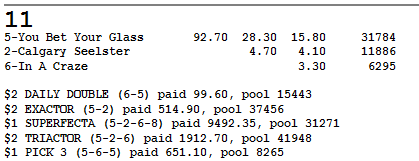
A $93 winner, with an even money shot out of the top four, where the last slot of the superfecta was filled with a 60-1 shot. You and I have maybe hit those type supers in the early 2000's. We walked home with the pool.

The Harville formula can be thrown right out the window with incremental betting.

On the flip side (here is why it is a tough question for tracks), fractional wagering drives handle, and it gives smaller players a chance to make a score. They are good for handle, and small customers like them because they can cash more tickets. They're not bad things.

I don't much look at Woodbine to play, mainly because of this dilution. I don't want to go through the hard work of finding horses that can pay, only to have the pay depressed. Not to mention, I believe twenty cent bets paying out with 25-28% takeouts is an elixir that is impossible to gain an edge at. It's a loser for me, no matter how good my handicapping is.

I suspect the best formula for fractional wagering is: Offer it, yes, but ensure the takeout is very low. If you are asking players to win 2,000-1 on something that is 10,000-1 at parlay or Harville, you are not forming a sound long-term growth strategy.


Saturday, March 2, 2013

Drops

I read an interesting discussion on class drops, and what to do with them, or what not to do with them today at Paceadvantage.com.

Class drops are always something to deal with, especially in the age of the supertrainer. "Class Handicapper" who usually makes solid points, I thought did again.

"Unless you have trainer specific information, I think you are generally at a disadvantage to the insiders that know the horse's current condition.

Many years ago I was hot walker one summer at Aqu. The barn I worked for had a horse that won her last race by 7 lengths, but we were dropping her from 25K to 20K. Bettors were rightfully suspicious and only made her 2-1. But they were guessing, otherwise they would have made her either even money or 10-1. I knew she should be 10-1 and played against her with confidence. She staggered home.


We had other situations where I knew the horse was OK and likely to fire.

It can't possibly be that I was the only one smart enough to both read the DRF and use inside information about the condition of a horse when I had it to make bets where I would have an edge over the public.


So until this day, when all I have is my personal speculation, I feel like I can't make an odds line. I don't know if the appropriate odds are 1-1 or 10-1. So I don't bet unless I don't like the horse even if it fires its "A" race."


 This is pretty interesting, and correct. Some class droppers are 10-1 or more fair odds, because sore horses who ran a 57 figure, will likely run a 37 figure - they don't win races. They aren't a 65% chance to win, they could be a 5% chance to win. That's a lot of variance.

We can do two things as handicappers: Ignore the race, or subset the data better by trainer. The former is easy, the latter is difficult at times.

I try my best to do the latter, though, because if you can pitch an odds on horse, you have a chance at a monster score.

One person I try to do this with is Jamie Ness. I noticed something that doesn't sit well with me for his drops, so I created a subset. I label it "Ness Negative Drop" and it shows up when I run my pp's. This is the model for 2012 so far:


For a trainer that hits at a high percentage, that is worthwhile.

I also try and find positive class drops, and subset those by trainer as well.

Not great, but not bad either.

Making money at racing is very difficult, but not impossible. I believe the only way to beat racing is betting horse's other people aren't. It does not mean pitching chalk and aiming high all the time. You need an unpublished edge.

Sometimes you can find one trainer only and it can help. Everyone can do it, with a little work. For example, maybe you notice David Jacobson drops a bunch of horses. Try and look at when they race super-hot, or when they are ice cold (finish position does not matter - just look at how they race, how well meant they are etc) and dive back into the PP's, work patterns or whatever, and see if a pattern emerges. Think of how profitable that can be.

One day, he has a 3-5 shot dropping in the third, and a 2-5 shot dropping in the 5th and you take a pick 4, going deep in those races, because your subset shows these are bad bets. If both lose, and you nab two bombers in those races, you can shoot and score a $10,000 pick 4. It can make your entire year.

This is probably my favorite part of horse racing - finding something that you can use, that others may not be using - even a computer team, or a rich whale. It's what makes the game very fun.

Notes: 

In HRU today another part of handicapping was looked at, but there is no solution for you and me at home: The Schooler. More and more trainers are using schooling races between starts to get their horse ready, but we have no idea when they take place, what the horse did or didn't do. The next time you see a horse win in 150 off a 156 qualifier three weeks ago, chances are he schooled in 54, maybe twice. We just had no idea.

We spoke about Pletcher's Derby record here last week, and I notice there was some chatter on the subject via Paceadvantage.com. Some folks on the thread make good points. The Toodster's record in all TC races, as well as the Breeders Cup is pretty poor, no matter how you slice it.

Enjoy your day everyone.


Friday, March 1, 2013

Winning

"Winning isn't everything, it's the only thing"  - Red Sanders

This applies to sports, but it applies to gambling, too.

Smart people like Caroline Betts or Dan Ariely can explain it via a textbook, but we all know we live it in our (hopeful) common sense lives.

Winning is fun, losing, well not so much fun.

Casino's operate with this in mind. Sure the craps table is a bad long term bet, but the pass is only a 1.41% juice, and that 1.41% is a loser tax that is offset. You can sometimes (a lot of the times) win, which makes you feel good. It keeps you coming back. If you lose, the casino attacks that "bad" feeling at the same time with the action and fun of the table, and a free meal, free drinks or room comp. "I lost $100, but I drank about seven free Coronas". That makes you feel like you won. 

Trading the stock market is not dissimilar. Back in the late 1990's when the tech boom was going on, we all made money. I remember being at a friend's house and she asked me "how to do it". She knew nothing of the markets, but she heard everyone was "winning". She needed to be a part of it. This helped E*Trade more than any talking baby did, or ever will. Winning is everything.

What about lotteries, you might say? Lotteries are not about winning, and they never have been. No one expects to win the $300 million power ball. The winning with a lottery is the endorphin rush  from imagining what it would be like to win, linked inexorably with a tiny opportunity cost. It costs $1 and a trip to the convenience store; where you are going anyway because you are short of milk. All for a chance to own my own island? Winning!

This is why it is so silly when some insiders will say "The lottery has high takeout, and people play it." Ask a lotto player to drive 40 minutes to the Belmont lotto center, pay to get in, study lotto manuals that you've gained from a lifetime of learning, and see how popular the lottery is. We really need to stop mentioning the lottery or lotto players when talking about racing. From now on: Twenty lashes with a wet noodle. 

At a racetrack winning is everything, too. The industry knows this. I ran into an industry insider who monitors player behavior (he shall remain nameless) several years ago and he said:

"It is absolutely amazing how much people bet when they're on a roll"

They bet more because they are winning. ADW's knew this early on. They would offer daily rebates. If you lost, well, here's $100 back. You won, come take another shot.

Winning is everything.

What separates racing and craps is that the entertainment is not there for racing (I am sorry to offend anyone who thinks watching a 5 claimer at Mountaineer is akin to watching the Dodgers and the Giants, but it's true), and it can't offer free room comps to a stall on the backstretch.  A racecard is five hours, too, and to play racing it takes skill and a lot of know-how. This is why every handicapper you and I know have a stack full of books on his or her bookshelf.

It's a whole different ball of wax.

At the present time, the only arrow in the quiver that racing has to help with winning is using the rake. I wish there were others, but there aren't. They can't make you pick the right horse, or do a heck of a lot to make the game more entertaining where the masses will drive to the track or OTB, scour programs, bet money and be a student of the game.

Tom LaMarra on Twitter said this yesterday:

On track player reward cards with real money back, not a toaster or gym bag, is something we've pushed here and at wagering conferences for years and years. This is a good thing for Saratoga to do. 

Why? Because when you give people cash back through a rake reduction they have a chance to feel they're winning. Winning is the best marketing program on the face of the earth.

Most Trafficked, Last 12 Months

Similar

Carryovers Provide Big Reach and an Immediate Return

Sinking marketing money directly into the horseplayer by seeding pools is effective, in both theory and practice In Ontario and elsewher...